

Understanding Your Ground Termite Treatment
The concept of a ground termite treatment is quite simple: the intent is to establish a continuous chemical barrier in the soil areas along all potential termite entry points. If the chemical barrier is properly established, it will prohibit termites from entering the structure.
The first step in a ground termite treatment is to identify the possible termite entry points. Your pest control professional should be knowledgeable in local construction techniques and should be able to identify possible entry points as well as appropriate means to treat them.
The quality as well as the price of a ground termite treatment can vary greatly. Things that affect the quality of the treatment include the drill hole spacing, type of termiticide, and in some cases, areas that should be treated can be a matter of opinion. Since you are making a considerable investment in your treatment, all of these factors should be made clear to you. We recommend that you ask your pest control professional for a diagram indicating what will be treated as well as method of treatment.
Drill Hole Spacing
If slab areas need to be drilled and treated, the distance between drill holes plays a critical role in the quality of the treatment as well as the pricing. The closer together the drill holes the more likely it is that a continuous chemical barrier will be established. If there is any breach in the barrier, the termites are likely to find it. When feasible, Structural Pest Control places their drill holes at 12" intervals.
Drill Hole Placement
The most common types of construction and methods of termite treatment are indicated below in figures 1, 2, and 3. Note the concrete footings which are typically placed along the perimeter and load bearing walls of the house. These footings provide added strength for the loads that will be placed on top the slab.
Figure 1 indicates a typical masonry block house. The footing is poured first, then the masonry block is laid on top the footing. The interior slab is then poured against the masonry block. Where the slab meets the masonry block a joint is formed from which termites may enter the structure. In this case, it is necessary to drill through the slab along with the interior of the house and inject chemicals along this joint in order to form a continuous chemical barrier. Additionally, masonry blocks sometimes have voids that should be drilled and treated.
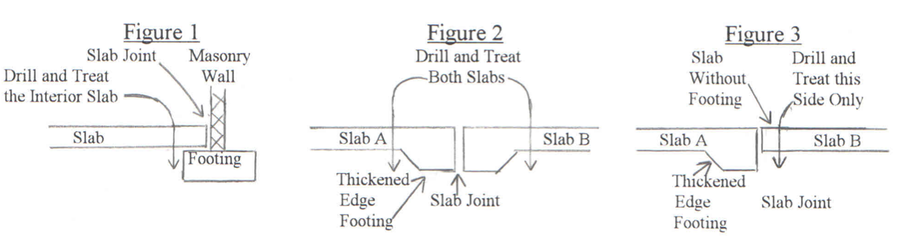
Figure 2 indicates two slabs, both of which have thickened edge footings. These footings are poured along with the main slab. A joint exists where the two thickened edge footings meet. The footings are usually too thick to drill. Therefore, it is necessary to back off from the wall and drill through the thinner slab portion. In order to increase the likelihood that a proper chemical barrier will form under the slab joint, both slabs should be drilled and treated.
Figure 3 illustrates a slab with a footing that abuts a slab without a footing. This is typical of a main house slab that abuts a sidewalk slab. In this case, proper termite protection can be achieved by only drilling the slab without the footing.
Chemical
The type of termiticides and concentration of the termiticides available vary greatly. Recent test data indicates that the termiticide Termidor is on of the most effective and longest lasting.
Soil Treatment
Soil that abuts the house should be trenched and treated with termiticide. A small trench to contain the termiticide is dug in the soil where it abuts the structure. An appropriate amount of termiticide is then injected into the trench. The soil is then placed back into the trench.
Plumbing Penetrations
Potential termite entry points exist where piping enters the interior of the house through the slab. There is typically enough space for termites to enter the house between the pipe and the slab that is poured around and against the pipe. Drill holes should be placed in close proximity to the pipes and the area treated.
Bathtub Traps
Directly below the bathtub drain is an area that is usually exposed soil. In order to treat this, a hole approximately 1.5" is drilled through an opposing wall. Termiticide is then injected into the exposed soil through this hole. The hole in the wall is then covered with a "blank" electrical cover plate.
Retainer and Rock Walls
Retainer and Rock Walls, for various reasons, are extremely difficult to properly treat for termites. Speak to your pest control professional for more details.
Vinyl Tile
When it is necessary to drill through a slab with vinyl tile, a special tile punch is used to cut out a piece of tile approximately 9/16" in diameter. After drilling through the slab and treating, the drill hole is patched with concrete and the tile plug that was originally removed is then glued back over the drill hole. This helps maintain the aesthetics of the flooring.
Ceramic Tile
If there is adequate space along the grout line of the tile then we drill through the grout and treat the area beneath the slab. After patching the slab penetration with concrete a matching grout is then used for finishing purposes. This helps maintain the aesthetic quality of the flooring. If there is not adequate space along the grout line, then the tile is subject to chipping.
The customer is required to provide a minimum access of 3 feet along all areas to be treated. This usually entails moving furniture, etc., which should be done prior to our arrival.
Marble, Wood, Others
If it is necessary to drill through these materials, outside specialty contractors can be employed to pre-drill these areas and patch them back up.
Preparation by Customer
The customer is required to provide a minimum access of 3 feet along all areas to be treated. This usually entails moving furniture, etc., which should be done prior to our arrival.

99-1191 Iwaena St., Aiea, HI 96701
Fax: 808-487-2956
License No. PC-489
Professional.
Prompt.
Courteous.
Find us on Facebook
 Share
Share
 Print
Print